 Spooning (aka: “jigging”) is one deadly technique for ocean salmon, halibut, yellowtail and rockfish, along with trout, landlocked salmon, striped bass and walleye in freshwater.
While it’s a super easy technique to learn, there are some little twists and tweaks that can help you take your jigging to the next level. If you’re game, read on!
RIGGING UP & THE BIG SECRET
For spooning, you want a rod that’s got some oomph in the lower two thirds – so you can muscle fish out of deep water and also move the spoon. But it should also have some give in the tip so that a fish can suck down your spoon and not feel too much resistance. Casting gear is the only way to go, as it’s really hard to make subtle adjustments with spinning tackle.

Inhaled! Stripers and rockfish love the P-Line Laser Minnow!
I like a baitcaster with a high-speed retrieve (above 7:1) if I’m working deep water, or a lower speed, more torquey model when trying to wench big fish out of the rocks. When it comes to line, keep this in mind: braid…braid…braid. There’s no other choice for jigging. Braided line has a slim profile so it is less subject to current drag, has no stretch (great for deep water), and is super durable and very sensitive.
Now, here’s the super top secret rigging tip I can throw at you to make your jigging much more effective: Run a heavy mono leader – the heaviest you can get away with without spooking the fish. For example, I’ll run a 10- to 15-foot section of 40-pound when jigging mackinaw. The lakers rarely get over 15 pounds where I fish, so it’s not the strength of the line I’m looking for but the thick diameter. The heavy line acts almost like a parachute for the lure, slowing it’s fall and thus making it flutter more enticingly. You’d be amazed how much of a difference this makes!
If you’re trout fishing in a lake, 20-pound seems to do the trick and I’ve gone as heavy as 60 plus when in the ocean.
SPOONS
When it comes to choosing a spoon, there are several things to consider. What does the natural forage in the area look like? In most cases, I try to “match the hatch” as much as possible and use the jig that best matches the profile and color of the local baitfish. When deep bodied fish like shad or sardines are the main menu items, I’ll go with a spoon like the Revenge or a Blade Runner Spoon. The Livingston EBS Spoon with Electronic Baitfish Sound is a good one at times, too.
But if narrow baitfish are what the fish are dining on, a slender jig like a [easyazon_link identifier=”B003D93PVG” locale=”US” tag=”fiwijd-20″]P-Line Laser Minnow[/easyazon_link] or [easyazon_link identifier=”B000LF03QU” locale=”US” tag=”fiwijd-20″]Hopkins Spoon[/easyazon_link] will get the job done.

Silver or white are great all-around colors as most baitfish have some sort of shiny hue to them. However, when I’m bouncing rock piles for rockfish and lings, I’ll often switch to a darker lure – something brown, dark green or black – to match the myriad of juvenile rockfish that inhabit these areas.
In freshwater, the same concepts apply. I’ll go with a wider-bodied spoon when threadfin shad are the primary baitfish and then use a more streamlined model when the fish are eating pond smelt. Kokanee are a bit of a wild card and they seem to prefer spoons with bright fluorescent finishes like hot pink, flame red and chartreuse.
As far as weight goes, you want to use the lightest lure you can get away with. It’s pretty simple: the lighter the lure, the more flutter you get. And of course, the more your spoon is flashing like a wounded fish, the better!
Swap the Hooks!
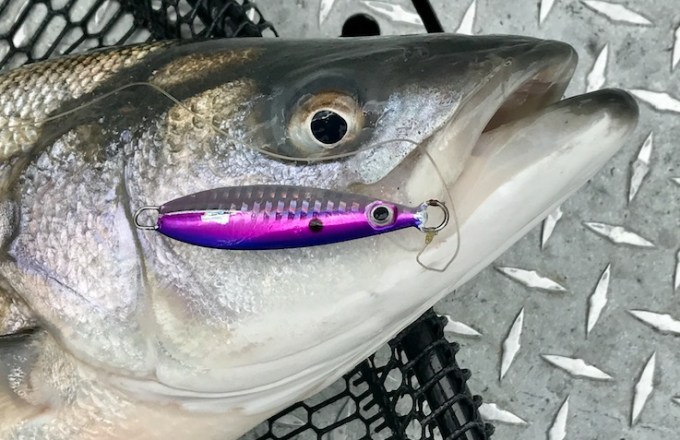
The majority of all jigging spoons come standard with treble hooks but I’ve never been all that fond of them. Taking a tip from the tropical saltwater guys, I started testing [easyazon_link identifier=”B000B5A5ZE” locale=”US” tag=”fiwijd-20″]assist hooks[/easyazon_link] out and have gone all in with them. If you’ve never heard of assist hooks, let me explain. They’re a single hook attached to a short length of cord that is fastened to the top eye of the spoon (yes, the top!). Some folks run two hooks up there but I’ve found one works great. I have to admit that a jig looks strange with the treble removed and the hook at the top, but they are deadly.

Assist Hooks look funny but they work!
Assist hooks are also much easier on the fish and are usually buried right in the corner of the jaw – not down in the gills. They’ve also been a godsend for me when jigging deep like I do for mackinaw at places like Lake Tahoe. So many times I’ve dropped a jig all the way down to 120 feet, only to have the lure flip and the treble wrap around the line just above the knot. Talk about frustrating! But that never happens with assist hooks!
Technique
One basic concept to keep in mind when spooning is: use your wrists, not your elbows or shoulders. Most of the time the best jigging motion is, with the rod tip angled towards the water, a quick upward snap of the wrist and then you allow the tip to fall back towards the water. There’s a fine line here – the lure will have the most action as it falls on a slack line. However, most strikes come as the lure is on the drop, so if you have too much slack in your line, you will miss a lot of bites.
The best way to describe it is, let your lure drop on a “controlled” fall in which you keep a little tension on the line. That’s where trouble comes in when the elbows and shoulders get involved – too high an upward stroke and you’ll almost assuredly have loose coils of line on the water, which translates into a lot of undetected strikes.

Yellowtail on light jigging tackle are a blast!
Bites can be slight “ticks” to outright arm yankers, but most are fairly subtle. For that reason, it’s a good idea to also watch your line where it enters the water. If you notice any slight hesitation or direction change, set the hook immediately!
One final note on technique: Try to keep your presentation as vertical as possible. The lures work best when presented straight up and down over the fish and you’re less prone to snags that way. If the current or wind is pushing the boat along so quickly that you have a pretty good line angle going, either reel up and drop again or try a heavier lure.


 Another cool thing about jigging is you don’t need a lot of sophisticated gear (besides good electronics). I like to fish with 6 1/2- to 7-foot casting rods rated for 8- to 15-pound line. You need enough backbone to be able to set the hook in deep water, but a sensitive tip so you can feel the bite – which, by the way, often come as the lure is falling. Some good ones to check out include the


